Milk and its derivatives are some of the most consumed foods across the world, thus food safety becomes one of the key issues for the dairy companies. Milk naturally has nutrients, however it may have also pathogens when produced in the uncontrolled environment. In order to make the process both safe for consumers and to preserve all nutrients in the milk, the dairy companies resort to pasteurizations.
99 Business Vyapar Industries, the recognized leader in producing milk processing plants, understands how crucial it is to ensure that the process of dairy production is safe and meets the modern standards of food safety. Modern technologies of pasteurization help dairy plants provide safe and fresh milk of high quality.
Nowadays, pasteurization is not only applicable to milk but also to fruit juices, beverages, liquids foods, sauces, cream, flavored milk and many other applications in food processing industries.
Pasteurizations Definition in Microbiology
It is essential that the pasteurizations definition microbiology should be understood by students as well as by dairies, food technology experts, and food manufacturers.
According to microbiology pasteurizations refers to a technique where the milk or any other liquid food product is heated at certain temperature level for a certain period of time and then cooled down fast. The idea behind this procedure is to get rid of all the bacteria causing diseases in the products and to preserve its natural taste, nutritional value, and quality.
Contrary to sterilization, pasteurizations does not kill all the microorganisms present. What it does is kills a great amount of harmful bacteria, thus making the food product stay fresh for more time.
The concept of pasteurizations in microbiology is one of the key methods of food preservation. It helps to reduce microbial contamination of the product without changing its natural properties.
What is Pasteurizations in Microbiology?
Apart from just heating milk, the importance of pasteurizations in microbiology is more about ensuring that all microorganisms that can interfere with food and humans’ safety are controlled.
Microbes that are found in foods like Salmonella, Listeria monocytogenes, E. coli, Campylobacter, and Mycobacterium tuberculosis are either killed or decreased to safe levels during pasteurization. On the other hand, valuable substances like proteins, calcium, vitamins, and minerals are not affected by this process.
In microbiology, pasteurizations also reduces the activities of enzymes that are involved in the spoilage of dairy products to ensure that manufacturers have better quality products.
This makes pasteurizations very important in microbiology for dairy industries, food processing plants, research laboratories, and beverage manufacturing firms.
Types of Pasteurizations
Different food products require different heating conditions. Therefore, manufacturers use various types of pasteurizations depending on production capacity, product characteristics, and desired shelf life.
1. Low-Temperature Long-Time (LTLT) Pasteurization
This traditional process heats milk to approximately 63°C for 30 minutes before rapid cooling.
It is commonly used by:
- Small dairy farms
- Traditional milk processing units
- Specialty dairy producers
Advantages
- Better flavor preservation
- Simple equipment requirements
- Suitable for small-scale production
Limitations
- Longer processing time
- Lower production capacity
- Not ideal for continuous industrial processing
2. High-Temperature Short-Time (HTST) Pasteurization
HTST is one of the most popular pasteurization methods used throughout the dairy industry.
In this process, milk is heated to approximately 72°C for 15 seconds before immediate cooling.
This method provides an excellent balance between food safety, nutritional retention, and production efficiency.
Advantages
- High production capacity
- Better energy efficiency
- Excellent microbial reduction
- Maintains milk quality and taste
- Continuous processing system
3. Ultra High Temperature (UHT) Pasteurization
Among all methods of pasteurization, UHT provides the longest storage life.
Milk is heated between 135°C and 150°C for only 2–5 seconds before being packed in sterile containers.
This allows milk to remain shelf-stable for several months without refrigeration until opened.
Advantages
- Long shelf life
- Maximum microbial safety
- Easy transportation
- Suitable for export markets
4. Batch Pasteurization
Batch pasteurization is another commonly used process where a fixed quantity of milk is heated, held for a specified time, and then cooled before the next batch begins.
This method is generally preferred for:
- Artisanal dairy products
- Specialty beverages
- Research applications
- Small production facilities
Although production capacity is lower than continuous systems, it offers greater flexibility and precise process control.
Understanding Different Pasteurization Methods
Selection of the best pasteurization process involves considerations of various factors such as the volume of production, capital invested in the process, type of product, and required shelf-life.
The commercial dairy plants usually rely on HTST process since it is efficient and operates continuously. However, the high-end dairy companies opt to use LTLT pasteurization process for specialty milk products, whereas companies distributing their products over long distances usually rely on UHT method.
Knowing the methods of pasteurization will help the dairy firms to optimize the process and meet food safety standards.
Importance of Pasteurization in Microbiology
Significance of pasteurization in microbiology can be attributed to the fact that the process helps in the production of safe foods without altering the nutritional value of the product. Milk naturally has microorganisms that are harmful as well as beneficial to the body. However, when milk is taken without the right precautions, the harmful bacteria will multiply and pose risks of infections.
Through pasteurization, harmful bacteria such as Salmonella, Listeria monocytogenes, Escherichia coli (E. coli), Campylobacter, and Mycobacterium tuberculosis are destroyed or reduced while at the same time maintaining the essential nutrients in milk like calcium, proteins, vitamins, and minerals.
Furthermore, from the microbiological point of view, pasteurization also slows down the activity of the enzymes that lead to spoilage and hence increasing the period of freshness of the milk products. Therefore, pasteurization in microbiology is the best method of preserving food in various industries.
Pasteurization Process – Step by Step
Although different pasteurization methods operate at different temperatures and holding times, the overall processing sequence remains nearly the same.
1. Raw Milk Collection
Fresh milk is collected from dairy farms and transported under hygienic conditions to the processing plant for further treatment.
2. Filtration and Pre-Cleaning
The collected milk is filtered to remove dust, dirt, straw particles, and other visible impurities before processing.
3. Pre-Heating
The milk is gradually heated to prepare it for the selected pasteurization process while maintaining product stability.
4. Heat Treatment
The product is heated according to one of the selected methods of pasteurization, such as LTLT, HTST, or UHT. During this stage, harmful microorganisms are destroyed or significantly reduced.
5. Holding Time
The milk is maintained at the required temperature for a specific duration to ensure effective microbial destruction without compromising product quality.
6. Rapid Cooling
Immediately after heating, the milk is rapidly cooled to approximately 4°C, preventing further bacterial growth and preserving freshness.
7. Hygienic Packaging
Finally, the pasteurized milk is transferred into sterilized containers or packaging systems under hygienic conditions before storage and distribution.
At 99 Business Vyapar Industries, we help businesses understand modern dairy processing technologies and connect them with advanced milk processing equipment for efficient and hygienic operations.
Comparison of Pasteurization Methods
Different pasteurization methods are selected depending on production capacity, product type, and storage requirements.
Low-Temperature Long-Time (LTLT)
LTLT operates at lower temperatures for a longer duration, preserving the natural flavor of milk. It is suitable for small-scale dairies but requires more processing time.
High-Temperature Short-Time (HTST)
HTST is the most commonly used commercial process because it provides excellent microbial safety while maintaining nutritional value and supporting continuous industrial production.
Ultra-High Temperature (UHT)
Among all methods of pasteurization, UHT provides the longest shelf life by destroying almost all microorganisms. It is ideal for packaged milk distributed over long distances.
Batch Pasteurization
Batch systems are best suited for specialty dairy products and research applications where flexibility is more important than production speed.
Choosing the correct types of pasteurization depends on factors such as investment cost, production volume, product quality expectations, and market demand.
Benefits of Milk Pasteurization
Modern pasteurization offers numerous advantages for both dairy businesses and consumers.
- Eliminates harmful bacteria and disease-causing microorganisms.
- Improves food safety and consumer confidence.
- Extends the storage life of milk and dairy products.
- Preserves natural taste, aroma, and nutritional value.
- Reduces the risk of milk spoilage during transportation.
- Maintains consistent product quality across production batches.
- Supports compliance with food safety regulations.
- Increases operational efficiency in dairy processing plants.
- Minimizes product wastage and financial losses.
- Enhances the overall quality of finished dairy products.
Uses of Pasteurized Milk
Pasteurized milk serves as the foundation for numerous dairy and food products.
It is widely used for:
- Packaged drinking milk
- Curd production
- Cheese manufacturing
- Butter production
- Ice cream manufacturing
- Flavored milk
- Paneer production
- Yogurt manufacturing
- Dairy beverages
- Bakery and confectionery products
- Food processing industries
- Commercial catering services
Because of its safety and extended shelf life, pasteurized milk has become the preferred choice for households and commercial food manufacturers.
Milk Pasteurizer in the Dairy Industry
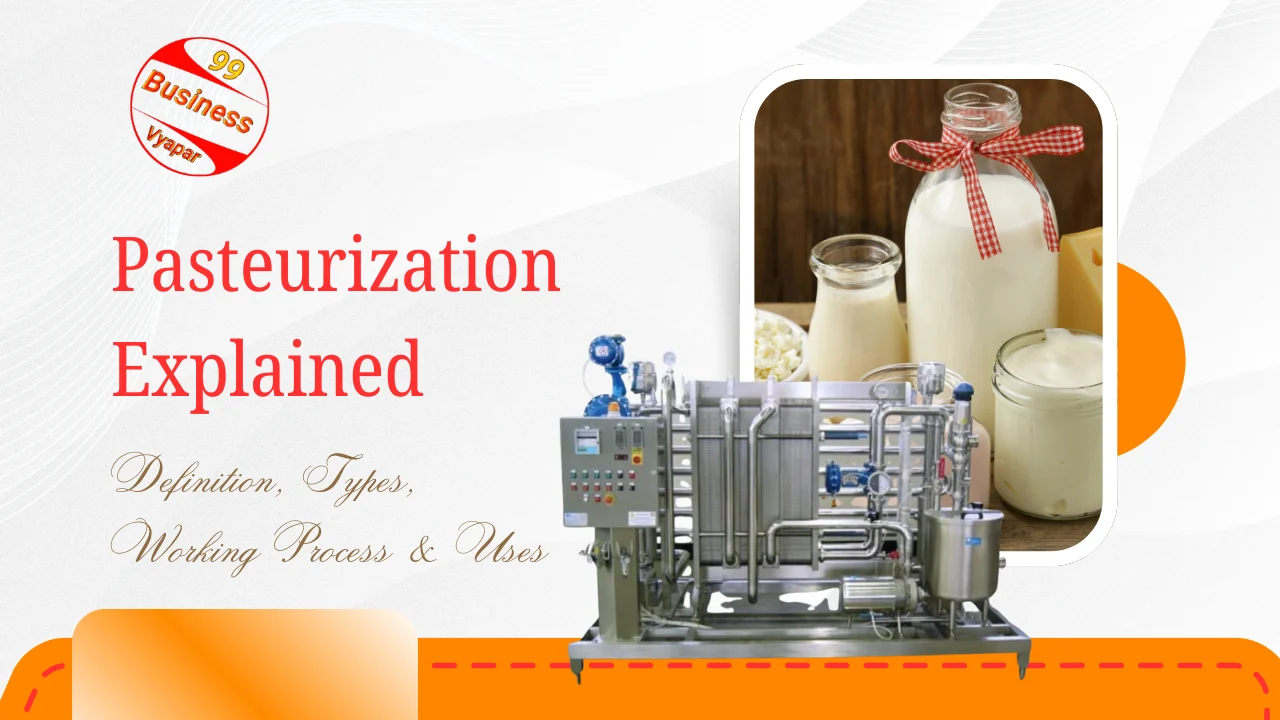
A Milk Pasteurizer is one of the most essential machines in any modern dairy processing plant. It is specifically designed to heat raw milk under controlled conditions, eliminate harmful microorganisms, and rapidly cool the product to maintain freshness.
Today’s dairy industries depend on advanced pasteurization systems to ensure product consistency, improve production efficiency, and comply with national and international food safety standards.
Modern pasteurizers include features such as:
- Automatic temperature control
- Stainless steel hygienic construction
- PLC-based operation
- Energy-efficient heat exchangers
- Continuous processing capability
- CIP (Clean-in-Place) cleaning systems
- Digital monitoring and process recording
At 99 Business Vyapar Industries, we understand how important reliable dairy equipment is for maintaining product quality. We help businesses discover advanced milk processing solutions, connect with trusted equipment manufacturers, and explore technologies that improve productivity, hygiene, and long-term operational efficiency.
Why Modern Pasteurization Systems are Essential
With an increase in the size of the dairy and food processing industry, the issue of keeping the products safe, hygienic, and consistent has become even more important. Modern pasteurization machines are equipped with state-of-the-art automation technology, temperature control, and efficient energy consumption technology to offer dependable operation and adherence to international food safety standards.
Compared to traditional heating technologies, modern pasteurizers provide even heat distribution, prevent product wastage, reduce expenses, and increase efficiency. Automated monitoring allows companies to keep track of their processing activities and make it easier to achieve quality assurance.
No matter whether a company uses hundreds of liters of milk or is a commercial dairy farm, proper investment in the pasteurization process will result in good quality products, happy customers, and profitability.
Industrial Applications of Pasteurization
Pasteurization technology is used across numerous industries where liquid food safety and microbial control are essential.
Dairy Industry
- Milk processing
- Flavored milk
- Cream processing
- Yogurt manufacturing
- Cheese production
- Butter production
- Paneer manufacturing
Beverage Industry
- Fruit juices
- Soft drinks
- Energy drinks
- Coconut water
- Herbal beverages
Food Processing Industry
- Sauces
- Tomato ketchup
- Liquid egg products
- Syrups
- Liquid food concentrates
Pharmaceutical Industry
- Nutritional liquid products
- Healthcare beverages
- Specialized food formulations
Why Choose High-Quality Pasteurization Equipment?
Selecting the right pasteurizations system offers several long-term business advantages.
- Improved food safety
- Higher production efficiency
- Longer product shelf life
- Reduced bacterial contamination
- Lower operational costs
- Better product consistency
- Energy-efficient operation
- Reduced product wastage
- Compliance with food safety regulations
- Improved consumer confidence
For dairy businesses, choosing reliable equipment is an investment that supports sustainable growth and better profitability.
Frequently Asked Questions (FAQs)
1. What is pasteurization?
Pasteurizations is a controlled heat treatment process that destroys harmful microorganisms while preserving the nutritional quality, taste, and freshness of food and beverages.
2. What is the pasteurization definition microbiology?
The pasteurizations definition microbiology refers to heating food or liquid products to a specific temperature for a fixed time and then rapidly cooling them to reduce harmful microorganisms without completely sterilizing the product.
3. Why is pasteurizations important in microbiology?
Pasteurizations in microbiology helps control pathogenic bacteria, reduces microbial growth, extends shelf life, and improves food safety without significantly affecting nutritional value.
4. What are the different types of pasteurization?
The major types of pasteurizations include:
- Low Temperature Long Time (LTLT)
- High Temperature Short Time (HTST)
- Ultra High Temperature (UHT)
- Batch Pasteurization
Each process is selected according to production requirements and product characteristics.
5. What are the common pasteurizations methods?
The most widely used pasteurizations methods are HTST, LTLT, and UHT. These methods of pasteurization differ in temperature, holding time, production capacity, and final shelf life.
6. Which industries use pasteurizations?
Pasteurizations is widely used in:
- Dairy Industry
- Beverage Industry
- Food Processing Industry
- Pharmaceutical Industry
- Nutraceutical Manufacturing
7. Does pasteurization affect nutritional value?
No. Proper pasteurizations preserves most vitamins, proteins, calcium, and minerals while making the product safe for consumption.
8. Which pasteurization method is best?
The best method depends on production capacity and business requirements. HTST is commonly preferred for commercial dairy plants, while UHT is ideal for products requiring an extended shelf life.
Conclusion
Pasteurization is still among the most efficient ways of assuring food safety, enhancing the quality of foods and increasing shelf-life. Knowing the pasteurization definition microbiology, significance of pasteurization in microbiology, the various types of pasteurization processes, and the numerous pasteurization methods techniques will help in choosing the appropriate technique for the manufacturing process.
The various techniques of pasteurization have specific benefits according to production volume, type of product and storage requirements. Whether opting for LTLT, HTST, UHT or batch pasteurization, choosing an appropriate method will allow businesses to produce hygienic and quality products as per food safety standards.
At 99 Business Vyapar Industries, our main aim is to offer industry-related information and assist businesses in finding advanced milk pasteurization solutions along with equipment manufacturers. Adoption of modern pasteurization technology will allow dairy and food processing businesses to be efficient in their operations, minimize losses of product, ensure superior quality products and gain trust of customers.