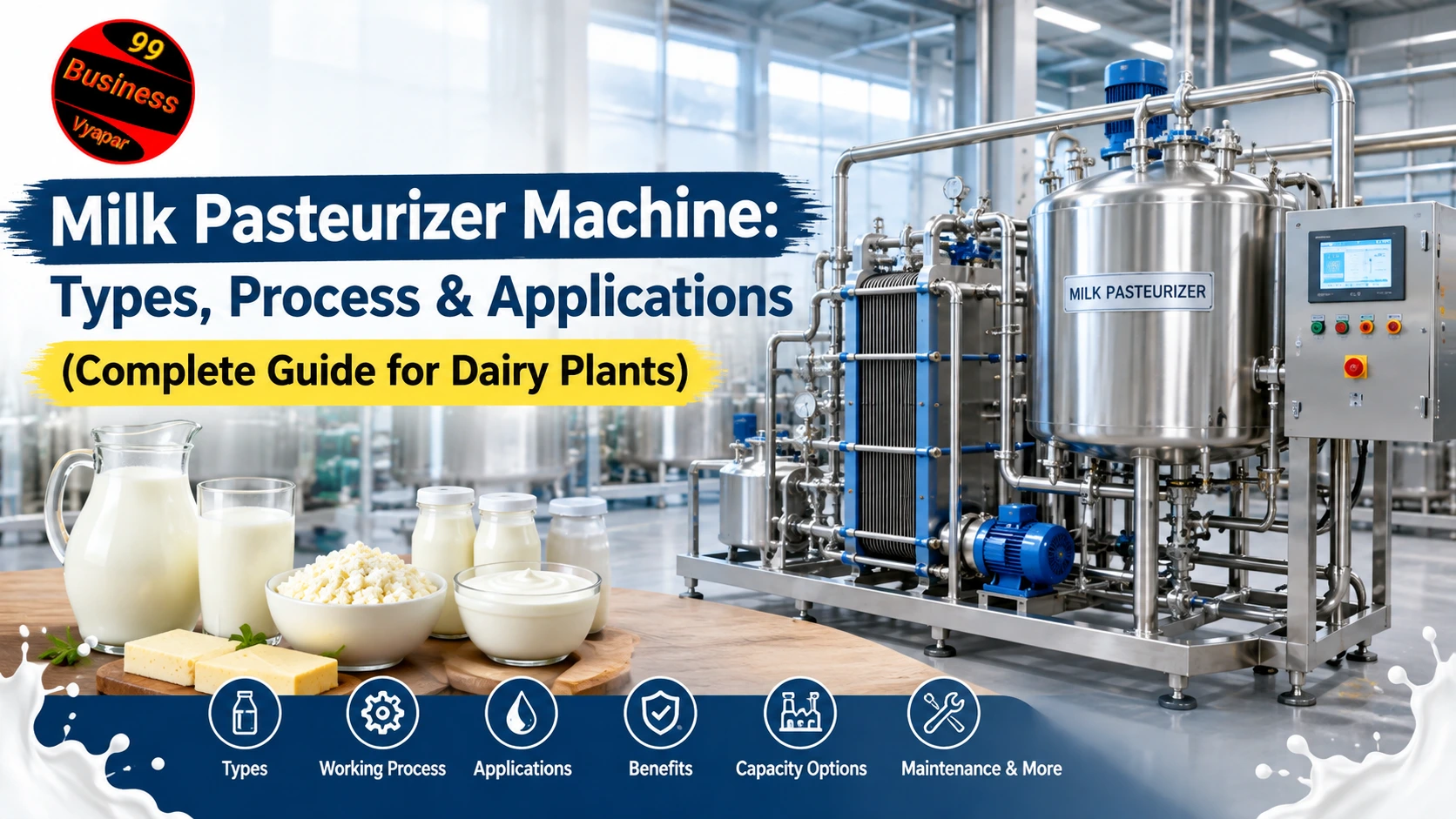
A milk pasteurizer machine is one of the most important pieces of equipment used in modern dairy processing. It helps dairy businesses heat milk at a controlled temperature for a specific time to reduce harmful microorganisms while maintaining the natural quality, taste, and nutritional value of milk. From small dairy units to large commercial plants, the right pasteurizer machine supports safe, hygienic, and consistent milk processing.
As dairy production continues to grow, the demand for an efficient milk pasteurization machine has also increased. A properly designed milk pasteurizer can improve product safety, increase production efficiency, and support better quality control. At 99 Business Vyapar Industries, we understand that every dairy plant has different production requirements, which is why choosing the right pasteurizing machine is essential for smooth and reliable dairy operations.
A high-quality milk pasteurizer machine is not simply a heating system; it is a complete temperature-controlled processing solution. It helps dairy plants process raw milk safely and prepare it for further products such as packaged milk, curd, yogurt, cheese, butter, cream, and other dairy products. With the right milk pasteurization machine, businesses can maintain hygiene standards and deliver consistent product quality.
What Is a Milk Pasteurizer Machine?
A milk pasteurizer machine is dairy processing equipment designed to heat raw milk to a predetermined temperature for a specific period and then cool it. This controlled heating process is called pasteurization. The primary purpose of a milk pasteurization machine is to reduce harmful microorganisms and improve the safety of milk without unnecessarily affecting its quality.
A modern pasteurizer machine uses accurate temperature control, heating systems, holding sections, pumps, and cooling arrangements to complete the process efficiently. Depending on production requirements, a milk pasteurizer can be designed for small-scale, medium-scale, or large-scale dairy plants.
The design and capacity of a pasteurizing machine may vary according to the quantity of milk processed per hour. Some systems are suitable for batch processing, while others are designed for continuous and high-volume production.
Milk Pasteurizer Machine – Technical Specifications
| Specification | Details |
|---|---|
| Capacity | 100–5,000+ Litres |
| Pasteurization Type | Batch / HTST / UHT |
| Material | Food Grade SS 304 / SS 316 |
| Heating System | Steam / Electric / Hot Water |
| Temperature Control | Digital / PLC Based |
| Heat Exchanger | Plate / Tubular Type |
| Automation | Semi-Automatic / Automatic |
| Application | Milk & Dairy Products |
| Cleaning | Manual / CIP System |
| Customization | Available as Required |
Why Is Milk Pasteurization Important?
Raw milk can contain microorganisms that may affect product safety and shelf life. The purpose of a milk pasteurizer machine is to apply controlled heat treatment that significantly reduces these microorganisms.
Milk pasteurization is important because it helps:
- Improve milk safety
- Maintain hygienic processing
- Reduce microbial activity
- Improve product consistency
- Support better shelf life
- Meet dairy processing standards
- Prepare milk for further processing
- Maintain controlled production conditions
An efficient milk pasteurization machine gives dairy operators greater control over the process. Instead of relying on manual heating methods, a professionally designed pasteurizer machine provides more accurate and repeatable results.
Milk Pasteurization Process: Step-by-Step
The process followed by a milk pasteurizer machine depends on the type of system and the pasteurization method. However, the basic processing stages generally remain similar.
Step 1: Raw Milk Collection
The process begins with the collection of raw milk. The milk should be handled under hygienic conditions before entering the milk pasteurizer.
Step 2: Filtration and Pre-Treatment
Before processing, milk may pass through filtration equipment to remove unwanted physical impurities. Depending on the dairy process, additional treatment may also be performed.
Step 3: Heating
The milk enters the milk pasteurization machine, where it is heated to the required temperature. The temperature is carefully controlled according to the selected pasteurization method.
Step 4: Holding Time
After reaching the required temperature, milk is maintained at that temperature for a specific holding period. This stage is extremely important for the proper functioning of a pasteurizing machine.
Step 5: Cooling
After pasteurization, the milk is rapidly cooled to a suitable temperature. Fast cooling helps maintain product quality and supports further processing or storage.
Step 6: Storage or Further Processing
The processed milk can then be transferred to storage tanks, packaging systems, or other dairy processing equipment.
A reliable milk pasteurizer machine performs these stages with controlled temperature and process management.
How Does a Milk Pasteurizer Machine Work?
The working principle of a milk pasteurizer machine is based on controlled heating and cooling. Milk passes through different sections of the equipment, where its temperature is managed according to the selected process.
In a typical pasteurizer machine, milk enters the system through a balance tank or feeding arrangement. Pumps move the milk through heating sections, where thermal energy raises its temperature. Once the required temperature is achieved, the milk remains in the holding section for the necessary period.
After the holding process, the milk pasteurization machine rapidly cools the milk. Advanced systems may also include automatic controls, sensors, valves, and monitoring systems.
The overall performance of a milk pasteurizer depends on proper temperature control, hygienic construction, efficient heat transfer, and reliable process automation.
Types of Milk Pasteurizer Machine
Different dairy plants require different processing methods. Therefore, a milk pasteurizer machine is available in several designs and technologies.
1. Batch Pasteurizer Machine
A batch pasteurizer machine processes a specific quantity of milk at one time. The milk is filled into a processing tank, heated to the required temperature, maintained for the required holding time, and then cooled.
A batch milk pasteurizer is commonly suitable for:
- Small dairy plants
- Pilot production units
- Local milk processing businesses
- Small-scale dairy product manufacturers
This type of pasteurizing machine offers a simple processing method and can be a practical option for businesses with lower production requirements.
2. HTST Milk Pasteurization Machine
HTST stands for High-Temperature Short-Time. This is one of the most commonly used methods in commercial dairy processing.
In an HTST milk pasteurizer machine, milk is heated to approximately 72°C for around 15 seconds, followed by rapid cooling.
HTST systems are suitable for dairy plants that require:
- Continuous processing
- Higher production capacity
- Consistent temperature control
- Improved processing efficiency
An HTST milk pasteurization machine often uses a plate heat exchanger for efficient heat transfer.
3. UHT Pasteurizing Machine
UHT stands for Ultra-High Temperature processing. In this process, milk is exposed to a significantly higher temperature for a very short period.
UHT processing is generally associated with long shelf-life milk products when combined with appropriate aseptic packaging systems.
A UHT pasteurizer machine is typically used in advanced commercial dairy operations with specialized processing and packaging requirements.
Milk Pasteurization Methods Comparison
| Pasteurization Method | Approximate Temperature | Holding Time | Suitable For |
|---|---|---|---|
| Batch Pasteurization | 63°C | Around 30 minutes | Small dairy plants |
| HTST | 72°C | Around 15 seconds | Medium and large dairy plants |
| UHT | 135°C or higher | Few seconds | Long shelf-life processing |
The actual configuration of a milk pasteurizer machine should be selected according to product requirements, production capacity, regulatory requirements, and overall plant design.
Main Components of a Milk Pasteurizer Machine
A modern milk pasteurizer machine consists of multiple components that work together to provide controlled processing.
Balance Tank
The balance tank supplies milk to the system and helps maintain a continuous flow during processing.
Milk Pump
A pump transfers milk through different sections of the milk pasteurization machine at a controlled flow rate.
Heat Exchanger
The heat exchanger is an important part of many continuous pasteurizer machine systems. It transfers heat efficiently between heating or cooling media and the milk.
Heating Section
This section increases the temperature of milk according to the selected pasteurization process.
Holding Section
The holding section ensures that milk remains at the required temperature for the specified duration.
Temperature Sensors and Controllers
These components monitor and control the process temperature. Accurate temperature management is essential for reliable milk pasteurizer performance.
Cooling Section
After heating, milk is cooled rapidly through the cooling section.
Control Panel
The control panel allows operators to monitor and manage different functions of the pasteurizing machine.
Applications of a Milk Pasteurizer Machine
A milk pasteurizer machine is used in many areas of the dairy industry. Its application is not limited to packaged drinking milk.
Common applications include:
- Pasteurized drinking milk
- Dairy processing plants
- Milk collection and processing centers
- Curd production
- Yogurt manufacturing
- Cheese production
- Flavored milk processing
- Cream processing
- Ice cream production
- Dairy product manufacturing units
A properly selected milk pasteurization machine can become an important part of an integrated dairy processing line.
Benefits of Using a Milk Pasteurizer
Investing in a professional milk pasteurizer machine offers several operational and quality-related benefits.
Improved Product Safety
Controlled heating helps reduce harmful microorganisms and supports safer dairy processing.
Consistent Processing
A modern pasteurizer machine provides controlled and repeatable temperature conditions.
Better Production Efficiency
Automated or semi-automated systems can reduce manual handling and improve workflow.
Hygienic Processing
Food-grade stainless steel construction and hygienic system design support clean dairy operations.
Better Quality Control
Temperature sensors and controllers allow operators to monitor the milk pasteurization machine more accurately.
Suitable for Different Capacities
A milk pasteurizer can be designed according to the production requirements of small, medium, and large dairy plants.
Milk Pasteurizer Machine Capacity Options
The capacity of a pasteurizing machine depends on the production requirement of the dairy plant. Manufacturers can offer different capacities based on litres per batch or litres per hour.
Common capacity ranges may include:
- 100 Litres
- 200 Litres
- 500 Litres
- 1,000 Litres
- 2,000 Litres
- 3,000 Litres
- 5,000 Litres
- Higher customized capacities
A small batch milk pasteurizer machine may be suitable for a growing local dairy business, while a high-capacity continuous milk pasteurization machine may be required for large commercial operations.
The best capacity should be selected by considering current production and future business growth.
How to Choose the Right Milk Pasteurizer Machine?
Choosing the right milk pasteurizer machine is an important decision because the equipment directly affects production efficiency and product quality.
1. Production Capacity
First, determine how much milk you need to process per day or per hour.
2. Pasteurization Method
Choose between batch, HTST, or another suitable processing technology based on your production requirements.
3. Automation Level
A pasteurizer machine may be manual, semi-automatic, or fully automatic. The right choice depends on operational requirements and budget.
4. Material Quality
Food-grade stainless steel is commonly preferred for hygienic dairy processing.
5. Temperature Control
Accurate sensors and reliable controllers are essential for the efficient operation of a milk pasteurizer.
6. Energy Efficiency
An energy-efficient milk pasteurization machine can help reduce operational costs over time.
7. Cleaning Requirements
Easy cleaning and maintenance should be considered while selecting a pasteurizing machine.
8. Future Expansion
Choose equipment that can support your future production plans.
Factors Affecting Milk Pasteurizer Machine Price
The price of a milk pasteurizer machine can vary depending on several factors. There is no single price suitable for every dairy plant.
Important factors include:
- Processing capacity
- Batch or continuous design
- Automation level
- Type of heating system
- Material grade
- Heat exchanger technology
- Control system
- Customization requirements
- Additional accessories
- Installation requirements
A basic pasteurizer machine for a small dairy unit may have a different investment requirement compared to a fully automated high-capacity milk pasteurization machine.
Instead of selecting equipment based only on the initial price, dairy businesses should consider long-term performance, maintenance, energy consumption, and production efficiency.
Maintenance Tips for a Milk Pasteurizer Machine
Regular maintenance helps maintain the efficiency and operational life of a milk pasteurizer machine.
Clean the System Regularly
Proper cleaning is essential to maintain hygiene. Dairy plants should follow recommended cleaning procedures.
Inspect Temperature Sensors
Temperature sensors should be checked regularly to ensure accurate process monitoring.
Check Pumps and Valves
Pumps, seals, and valves should be inspected for smooth operation.
Monitor Heat Transfer Performance
The heating and cooling sections of the milk pasteurization machine should be monitored to maintain efficient performance.
Follow Preventive Maintenance
Scheduled maintenance can help identify small issues before they become major operational problems.
A well-maintained milk pasteurizer can provide more reliable performance and reduce unexpected downtime.
Common Mistakes to Avoid When Buying a Pasteurizer Machine
Many dairy businesses focus only on capacity or price while purchasing a pasteurizer machine. However, several other factors are equally important.
Choosing Only on Price
A low-cost milk pasteurizer machine may not always provide the required quality, automation, or long-term reliability.
Ignoring Future Production Growth
Buying a system that only meets current requirements can create limitations when production increases.
Selecting the Wrong Technology
A batch pasteurizing machine may not be suitable for a dairy plant that requires continuous high-volume production.
Ignoring Cleaning Requirements
Poor cleaning design can create operational and hygiene challenges.
Not Checking After-Sales Support
Technical support and service availability are important for smooth operation.
Overlooking Energy Consumption
The long-term operating cost of a milk pasteurization machine should also be considered.
Why a Milk Pasteurizer Machine Is Important for Modern Dairy Plants
The dairy industry requires consistent quality, hygienic processing, and reliable production systems. A professionally designed milk pasteurizer machine helps dairy businesses meet these operational requirements.
From small local dairy units to large commercial processing facilities, the right milk pasteurizer can improve process control and production efficiency. Modern systems can also be integrated with other equipment such as milk storage tanks, homogenizers, cream separators, chilling systems, and packaging machines.
For businesses planning a complete dairy processing setup, equipment selection should be based on production requirements rather than simply choosing the most popular pasteurizer machine.
At 99 Business Vyapa, dairy businesses can explore suitable processing solutions and understand the equipment required for different production capacities and applications.
Frequently Asked Questions
What is a milk pasteurizer machine?
A milk pasteurizer machine is equipment used to heat milk at a controlled temperature for a specific period and then cool it. This process helps improve milk safety and supports hygienic dairy processing.
Which types of milk pasteurization machine are available?
Common types include batch pasteurizers, HTST systems, and UHT processing systems. The best milk pasteurization machine depends on production capacity and product requirements.
What is the difference between Batch and HTST pasteurization?
Batch pasteurization processes a fixed quantity of milk at one time, while an HTST pasteurizer machine is generally designed for continuous processing at higher production capacities.
What temperature is used in milk pasteurization?
Different methods use different temperature and holding-time combinations. For example, HTST processing commonly uses approximately 72°C for around 15 seconds.
How do I choose the right milk pasteurizer?
Consider production capacity, automation level, processing method, material quality, energy efficiency, cleaning requirements, and future expansion plans.
Can a milk pasteurizer machine be used for other dairy products?
Yes. Depending on the process design, a milk pasteurizer can support the processing of milk used for products such as curd, yogurt, cheese, flavored milk, and other dairy products.
What capacity milk pasteurizer machine should I choose?
The capacity should depend on your daily or hourly milk processing requirement. Small dairy units may require batch systems, while larger plants may need continuous high-capacity equipment.
How can I maintain a pasteurizing machine?
Regular cleaning, inspection of pumps and valves, temperature sensor checks, preventive maintenance, and proper operation can help maintain the performance of a pasteurizing machine.
Conclusion
A milk pasteurizer machine is a valuable investment for dairy businesses that want to improve product safety, processing consistency, and operational efficiency. Understanding the different types of milk pasteurization machine, including batch, HTST, and UHT systems, helps businesses select equipment according to their actual production needs.
Before purchasing a pasteurizer machine, it is important to evaluate capacity, technology, automation, material quality, energy efficiency, maintenance, and future expansion. The right milk pasteurizer can become the foundation of an efficient dairy processing operation and support the production of safe and consistent dairy products. By selecting a suitable pasteurizing machine and following proper maintenance practices, dairy plants can build a more reliable, hygienic, and productive processing system.