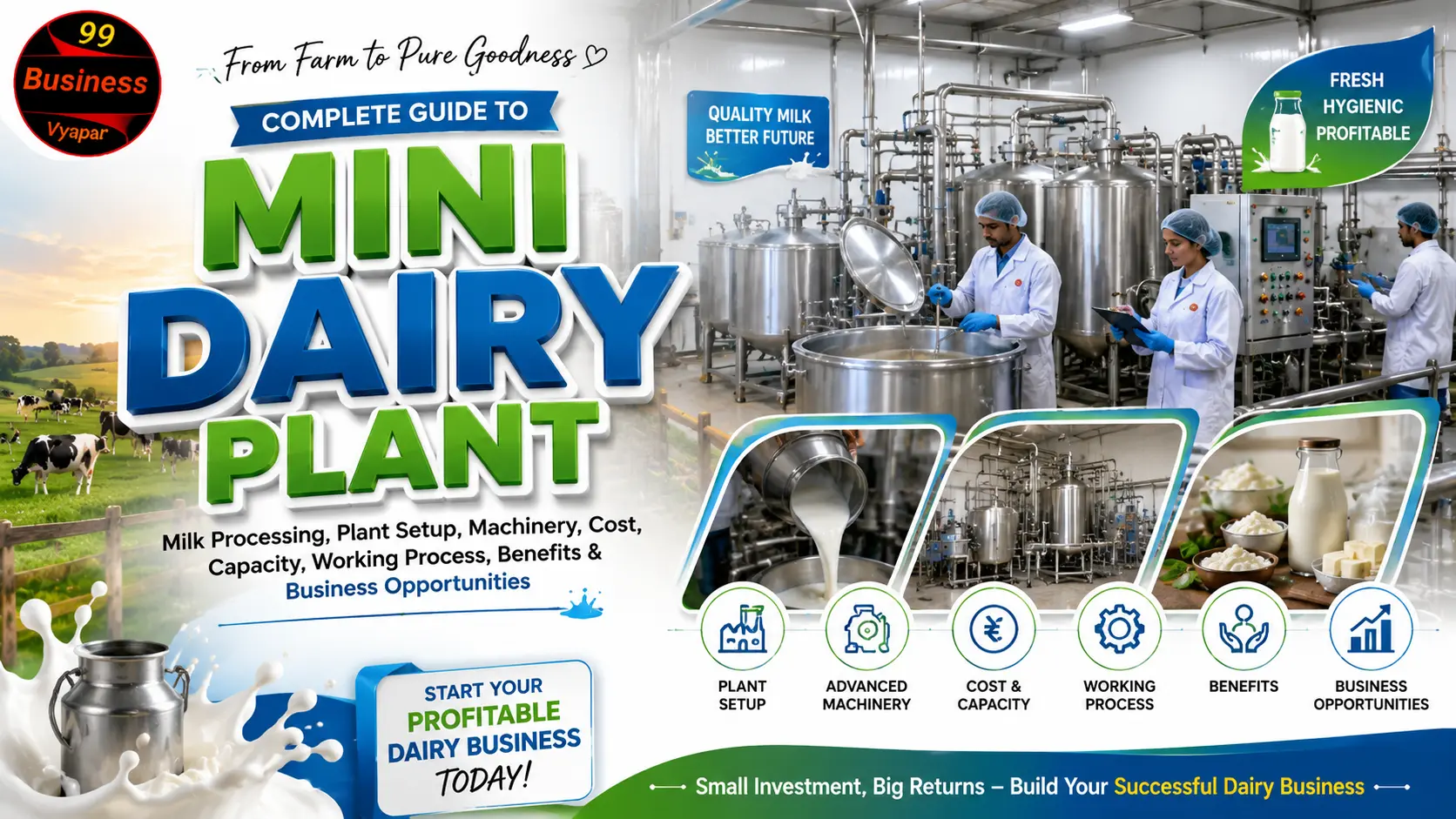
Introduction to Mini Dairy Plant, Milk Processing Plant
The dairy industry is growing rapidly as consumers demand fresh, hygienic, and high-quality milk and dairy products every day. However, many dairy entrepreneurs, cooperative societies, and livestock farming businesses struggle with challenges such as milk spoilage, inconsistent product quality, rising labor costs, and inefficient processing methods. A Mini Dairy Plant is designed to solve these problems by providing a compact, automated, and cost-effective solution for milk collection, processing, pasteurization, cooling, packaging, and storage. Whether you are planning to establish a mini milk processing plant for a village-level dairy business or expand an existing dairy farm, a well-designed processing unit ensures maximum productivity while maintaining food safety standards. At 99 Business Vyapar Industries, businesses can find reliable dairy processing solutions that help improve operational efficiency and deliver premium-quality dairy products to the market.
One of the most important factors in building a successful dairy business is selecting the right layout of milk processing plant. A scientifically planned plant layout allows milk to move smoothly through every stage—from raw milk reception to filtration, chilling, pasteurization, homogenization, storage, and final packaging—without the risk of contamination. A proper layout also reduces unnecessary manpower, minimizes product loss, improves workflow, and simplifies cleaning and maintenance. Whether the plant has a capacity of 200 LPH or several thousand liters per hour, an optimized layout increases production efficiency while ensuring compliance with food safety and quality regulations.
A modern mini dairy plant consists of several integrated machines that work together to produce safe and market-ready dairy products. These include milk reception tanks, milk chilling units, storage tanks, pasteurizers, homogenizers, cream separators, milk transfer pumps, plate heat exchangers, packaging machines, CIP (Clean-in-Place) systems, and stainless-steel pipelines. Each machine plays a critical role in preserving milk quality, extending shelf life, maintaining nutritional value, and reducing bacterial growth. Advanced automation further reduces human error, ensures precise temperature control, and improves overall production consistency, making the plant suitable for both startups and established dairy businesses.
The working process of a mini milk processing plant begins with collecting fresh milk from dairy farmers or livestock farming units. The milk is first tested for quality parameters such as fat content, SNF (Solid-Not-Fat), acidity, and microbial contamination before entering the processing line. It is then filtered to remove impurities and chilled immediately to preserve freshness. The milk passes through pasteurization, where harmful microorganisms are eliminated while retaining essential nutrients. Depending on the final product requirements, homogenization may be performed to improve texture and prevent cream separation. After processing, the milk is cooled again, stored in hygienic stainless-steel tanks, packaged in pouches or bottles, and prepared for distribution. This systematic process ensures consumers receive fresh, safe, and high-quality milk every time.
Many dairy business owners hesitate to invest in a processing plant due to concerns about high investment costs, complex operations, maintenance requirements, and uncertain returns. However, a properly designed Mini Dairy Plant addresses these challenges by offering scalable capacities, lower operational costs, reduced product wastage, and faster processing. Automation minimizes labor dependency, energy-efficient systems reduce electricity consumption, and hygienic processing helps businesses comply with food safety regulations. In addition, value-added products such as curd, paneer, butter, ghee, flavored milk, yogurt, and cream can be produced using the same plant, creating multiple revenue streams and significantly improving profitability.
The benefits of installing a Mini Dairy Plant extend far beyond milk processing. Businesses experience improved product quality, enhanced hygiene, longer shelf life, faster production cycles, consistent output, and lower maintenance costs. The compact design requires less installation space while offering flexibility for future expansion. Stainless-steel construction ensures durability, corrosion resistance, and easy cleaning, making the system suitable for continuous commercial operations. Small dairy owners, entrepreneurs, farmer-producer organizations (FPOs), cooperatives, and medium-scale diary farm operators can all benefit from increased productivity and better market competitiveness with a professionally engineered dairy processing solution.
Choosing the right equipment manufacturer is equally important for long-term business success. A trusted partner not only provides high-quality machinery but also offers expert guidance on plant design, equipment selection, installation, commissioning, training, and after-sales support. 99 Business Vyapar Industries specializes in delivering advanced Mini Dairy Plant solutions that are customized to meet different production capacities and business requirements. From designing the ideal layout of milk processing plant to supplying reliable processing machinery, the company helps businesses establish efficient, hygienic, and profitable dairy operations. Whether you are launching a new mini dairy project or upgrading an existing mini milk processing plant, investing in modern dairy technology is a smart step toward sustainable growth, higher production efficiency, and long-term business success.