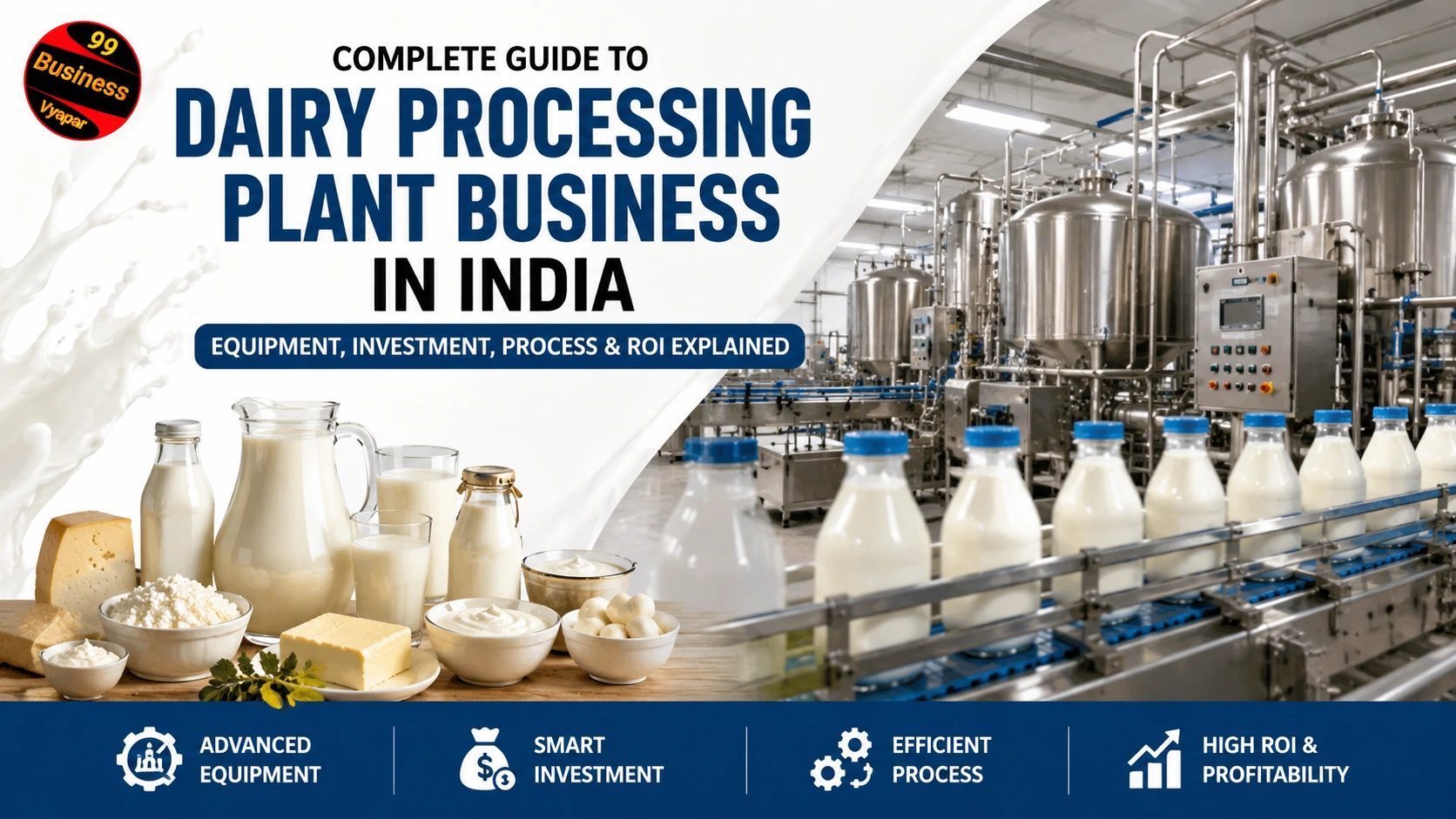
India stands as a major global milk producer and consumer, which establishes the dairy industry as a profitable business sector that provides future growth opportunities to both new entrepreneurs and existing industrial investors. A Dairy Processing Plant Business in India experiences substantial growth because of three main factors: population growth, urban development, and increasing consumer demand for hygienic dairy products with added value. The market shows rapid development, which creates ongoing possibilities for businesses to achieve both growth and financial success through their product range that includes packaged milk and cheese, butter and ghee, and flavoured beverages.
The government system establishes financial support through subsidies and simple loan options, which enable small and medium businesses to enter this industry sector with greater ease. Businesses can expand their market reach through proper investments in both infrastructure and equipment. 99 Business Vyapar Industries presents to you this comprehensive guide, which details all essential elements of your dairy processing business from equipment selection and process optimisation to your financial strategies and potential profitability.
Dairy Processing Plant India
A dairy processing plant in India refers to a facility that processes raw milk into value-added dairy products through its collection, testing and processing operations. The demand for hygienic and packaged dairy products is increasing rapidly across urban and rural markets. The industry expansion has led to the establishment of contemporary facilities that use automated technology to guarantee their products meet quality and safety standards while operating with maximum efficiency.
The dairy industry in India benefits from its robust supply chains, cooperative networks, and government programs, which help new business owners to establish their companies. A dairy plant can operate successfully in both local and national markets when it receives appropriate planning and technological support.
Milk Dairy Processing Plant
A milk dairy processing plant is specifically designed to handle milk processing operations, starting from collection to packaging. The core function of such a plant is to maintain milk quality while extending shelf life.
The process usually includes:
- Milk reception and testing
- Filtration and clarification
- Pasteurization
- Homogenization
- Storage and packaging
Advanced plants use automated control systems to monitor temperature and hygiene levels throughout production. This ensures that the final product meets industry standards and consumer expectations.
Dairy Processing Plant Layout
An efficient dairy processing plant layout is essential for smooth operations and productivity. The layout should be designed in a way that minimizes contamination risks and allows easy movement of raw materials and finished goods.
Key areas in a well-designed layout include:
- Milk reception dock
- Processing section
- Storage tanks
- Packaging area
- Cold storage
- Quality testing lab
A proper layout not only improves workflow but also ensures compliance with food safety regulations. It helps in reducing operational costs and
enhancing overall plant efficiency.
Dairy Processing Plant Cost
Understanding the dairy processing plant cost is crucial before starting your business. The investment depends on several factors such as plant capacity, level of automation, land cost, and type of products being processed.
Approximate cost considerations include:
- Land and building infrastructure
- Machinery and equipment
- Installation and commissioning
- Labor and operational expenses
For a medium-scale plant, the investment can range from ₹50 lakhs to several crores. However, government subsidies and financing options can significantly reduce the financial burden. Proper budgeting and financial planning are key to long-term success.
Dairy Processing Plant Sanitation
Dairy operations require strict hygiene maintenance because the sanitation of dairy processing plants serves as a vital component for ensuring product safety. The high perishability of milk makes it vulnerable to contamination when sanitation procedures remain unimplemented.
Important sanitation practices include:
- Regular cleaning of equipment using CIP (Clean-In-Place) systems
- Sterilisation of storage tanks and pipelines
- Personal hygiene of workers
- Proper waste disposal management
Following strict sanitation protocols not only ensures compliance with food safety standards but also builds trust among customers.
Small Dairy Processing Plant Layout
A small dairy processing plant layout is designed for startups or small-scale entrepreneurs who want to enter the dairy industry with limited investment. Despite the smaller size, the layout must still follow hygiene and efficiency standards.
Typically, a small layout includes:
- Compact milk reception unit
- Basic processing equipment
- Small packaging section
- Limited cold storage
A well-planned small layout can help maximise productivity while keeping operational costs under control.
Small Dairy Processing Plant India
The concept of a small dairy processing plant India is gaining popularity due to increasing demand for local and fresh dairy products. Small plants are ideal for rural and semi-urban areas where milk availability is high.
These plants offer advantages such as:
- Lower initial investment
- Easy management
- Quick return on investment
- Ability to serve local markets efficiently
Entrepreneurs can start with basic products like pasteurised milk and gradually expand into value-added products like paneer, curd, and flavoured milk.
Milk Tanker Unloading at Dairy Processing Plant
The process of milk tanker unloading at dairy processing plant is a critical first step in maintaining milk quality. Raw milk is transported from farms to the plant in insulated tankers to preserve freshness.
During unloading:
- Milk is tested for quality parameters such as fat and SNF content
- It is filtered to remove impurities
- The milk is then transferred to storage tanks under controlled conditions
Proper handling during this stage ensures that only high-quality milk enters the processing cycle.
Dairy Processing Plant India Small Scale
A dairy processing plant India small scale is an excellent business opportunity for entrepreneurs looking for a low-risk entry into the dairy industry. These plants focus on limited production but maintain high quality.
Key features include:
- Affordable machinery
- Reduced operational complexity
- Flexibility in product range
- Local distribution focus
With the right strategy, small-scale plants can grow into large operations over time.
Dairy Processing Plant Sanitation Slideshare
Many professionals refer to dairy processing plant sanitation slideshare resources for training and awareness. These materials help clarify standard hygiene practices, cleaning methods, and compliance requirements in an easy-to-visualise format.
Such educational resources are useful for:
- Training new employees
- Improving operational standards
- Staying updated with industry norms
Continuous learning and training ensure that the plant maintains high-quality production standards.
Essential Equipment Used in Dairy Processing Plants
To run a successful dairy plant, using the right machinery is crucial. Some of the commonly used equipment includes:
- Milk storage tanks
- Pasteurizers
- Homogenizers
- Cream separators
- Milk chilling units
- Filling and packaging machines
Modern equipment improves efficiency, reduces manual labour, and ensures consistent product quality.
Dairy Processing Business Process Overview
The dairy processing business follows a systematic workflow:
- Milk collection from farms
- Transportation in insulated tankers
- Quality testing and filtration
- Pasteurisation and homogenisation
- Product conversion (milk, butter, cheese, etc.)
- Packaging and distribution
Each stage must be carefully monitored to maintain quality and hygiene standards.
Dairy Processing Plant Specification Comparison (Small vs Medium vs Large Scale)
| Parameter | Small Scale Plant | Medium Scale Plant | Large Scale Plant |
|---|---|---|---|
| Plant Capacity | 500 – 2,000 LPH | 2,000 – 10,000 LPH | 10,000 – 50,000+ LPH |
| Automation Level | Manual / Semi-Automatic | Semi-Automatic / Automatic | Fully Automatic |
| Space Requirement | 500 – 1,500 sq. ft. | 1,500 – 5,000 sq. ft. | 5,000 – 20,000+ sq. ft. |
| Power Consumption | Low (10–25 kW) | Moderate (25–80 kW) | High (80–300+ kW) |
| Manpower Requirement | 3 – 10 Workers | 10 – 25 Workers | 25 – 100+ Workers |
| Product Range | Milk, Curd, Paneer | Milk, Butter, Ghee, Cheese | Full Dairy Range + Value-added Products |
| Machinery Type | Basic Equipment | Standard Industrial Machines | Advanced & High-Capacity Machinery |
| Production Efficiency | Moderate | High | Very High |
| Maintenance Cost | Low | Medium | High |
| ROI (Return on Investment) | 1 – 2 Years | 2 – 3 Years | 3 – 5 Years |
| Market Reach | Local / Nearby Areas | Regional Market | National / Export Market |
| Flexibility | High (Easy to Modify) | Moderate | Low (Fixed Large Setup) |
| Installation Time | 10 – 20 Days | 20 – 40 Days | 45 – 90 Days |
Applications of Dairy Processing Plant
- Production of pasteurised and packaged milk for daily consumption
- Manufacturing of value-added products like butter, cheese, paneer, and ghee
- Processing of flavoured milk, yoghurt, and dairy beverages
- Supply of dairy ingredients to the food and bakery industries
- Bulk milk processing for hotels, restaurants, and catering businesses
- Export-oriented dairy product manufacturing
- Production of milk powder for long-term storage and distribution
- Support for cooperative dairy societies and local milk collection centres
Benefits of Dairy Processing Plant
- Ensures hygienic and safe milk processing with modern technology
- Increases the shelf life of milk and dairy products
- Generates high profit through value-added dairy items
- Creates employment opportunities in rural and urban areas
- Reduces milk wastage with proper storage and processing
- Supports farmers by providing stable milk procurement systems
- Scalable business model from small to large industrial level
- Strong market demand with consistent consumption across India
- Improves product quality and brand value in competitive markets
- Enables efficient supply chain and wider distribution reach
Why Choose 99 Business Vyapar Industries?
- Industry Expertise & Knowledge – 99 Business Vyapar Industries has strong experience in delivering reliable solutions for the dairy and food processing sector, helping businesses make informed decisions.
- End-to-End Business Support – From planning and setup to execution, the company provides complete guidance for establishing a successful dairy processing plant.
- High-Quality Machinery Solutions – They focus on providing durable, efficient, and modern equipment that ensures smooth operations and long-term performance.
- Customised Plant Solutions – Every business has different needs, and 99 Business Vyapar Industries offers tailored solutions based on capacity, budget, and production goals.
ROI and Profit Potential
A Return on investment (ROI) in the dairy processing business depends on factors like production capacity, product range, and market demand. Value-added products like cheese, butter, and flavoured milk products generate higher profit margins than raw milk products.
A dairy plant needs proper planning to achieve an ROI between 1 and 5 years. The three main factors that drive profits include maintaining consistent product quality and running efficient business operations, and developing effective distribution systems.
Conclusion
India offers an appealing business opportunity through its dairy processing industry because it guarantees sustained growth prospects. Entrepreneurs can establish successful and sustainable businesses through their dedication to proper planning, efficient layout design, advanced machinery and strict hygiene standards. The dairy industry needs 99 Business Vyapar Industries to provide businesses with essential insights and solutions which will help their operations succeed.