Milk Homogenized super popular all over the world because it’s both yummy and good for you. People want it to be smooth and consistent whether they’re drinking it, cooking with it, or using it to make other foods. That’s where homogenization comes in – it makes sure milk meets those expectations.
Ever wondered what is homogenized milk? And how does it differ from regular milk? Well, at 99 Business Vyapar Industries, we think knowing about dairy processing can help everyone – from customers to dairy owners – make smart choices. So in this article, we’ll look at the whole deal on homogenized milk: its creation, the advantages, the impact, and why it’s such a big deal in the dairy business today.
What Is Homogenized Milk?
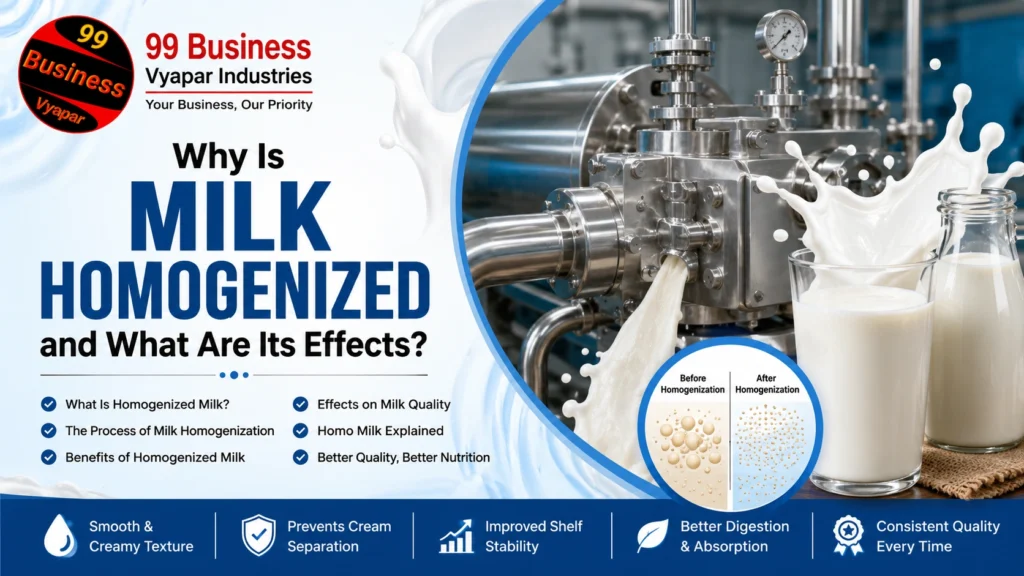
Homogenized milk is just regular milk that has gone through a process to break down its fat globules into tiny, even pieces. This stops the cream from rising to the top and separating.
A lot of folks wonder what the deal with is homogenized milk. It basically stays all mixed up with a consistent texture from start to finish – no more layers of cream floating on top. So, it looks and feels really smooth and creamy throughout.
When we talk about homogenized milk meaning, we’re really talking about making it look good and stable on the shelf. The fat particles are so small they stay evenly scattered, which makes the milk appealing and easy to drink.
Understanding the Process of Milk Homogenization
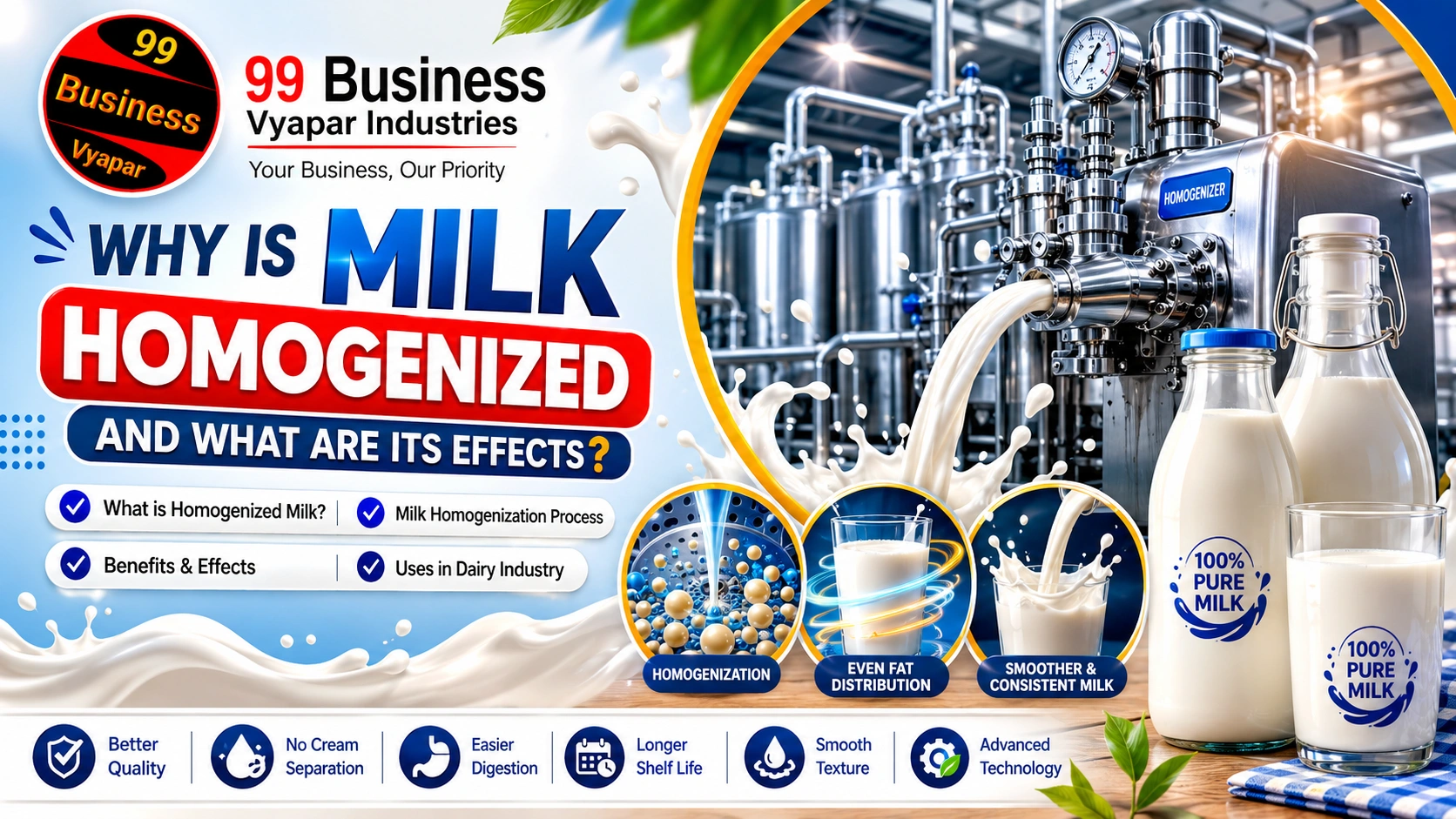
The process of milk homogenization involves forcing milk through very narrow openings under extremely high pressure. During this stage, large fat globules are broken into microscopic particles that remain suspended throughout the milk.
The basic steps involved in homogenization of milk include:
Collection and Filtration
Fresh milk is collected from dairy farms and filtered to remove impurities before processing.
Pasteurization
The milk is heated to eliminate harmful bacteria and improve safety.
Homogenization Process
The milk is pushed through a homogenizer machine at high pressure. This mechanical action breaks the fat molecules into smaller particles.
Cooling and Packaging
After homogenization, the milk is cooled and packed hygienically before distribution.
This advanced processing method ensures that every glass of milk provides the same texture and taste.
Why Is Milk Homogenized?
There are several reasons dairy companies prefer homogenization of milk:
Prevents Cream Separation
Before the invention of homogenization technology, cream would naturally rise to the top of milk containers. Homogenization keeps the fat evenly distributed.
Improves Texture
Homogenized milk has a smoother and richer mouthfeel compared to non-homogenized milk.
Better Appearance
Consumers generally prefer milk with a consistent appearance and uniform texture.
Enhanced Shelf Stability
Milk remains stable for longer periods without visible fat separation.
Easier Digestion for Some Consumers
Because the fat globules are smaller, some people find homogenized milk easier to digest, although scientific opinions on this aspect vary.
What Is Homo Milk?
In many countries, particularly Canada, the term homo milk is commonly used. Homo milk refers to homogenized milk that typically contains around 3.25% milk fat.
The phrase homo milk simply represents milk that has undergone the homogenization process. Therefore, when consumers purchase homo milk, they are essentially buying homogenized whole milk with a uniform texture and creamy consistency.
Homogenized Milk vs Non-Homogenized Milk
Many consumers are curious about the differences between these two types of milk.
Homogenized Milk
- Uniform texture
- No cream layer on top
- Smooth appearance
- Longer visual stability
- Widely available in supermarkets
Non-Homogenized Milk
- Cream rises naturally to the top
- Requires shaking before use
- Traditional appearance
- Often preferred by consumers seeking minimally processed products
Both options provide similar nutritional value, but their texture and appearance differ significantly.
Effects of Homogenization on Milk
The effects of homogenization are primarily physical rather than nutritional. The process changes the structure of fat particles but does not significantly alter the nutritional content of milk.
Improved Consistency
One of the most noticeable effects is the uniform distribution of fat throughout the milk.
Creamier Taste
The smaller fat globules create a richer and smoother mouthfeel.
Better Product Quality
Homogenized milk offers a consistent experience from the first sip to the last.
Enhanced Processing Efficiency
Modern dairy industries rely on homogenization to maintain product quality across large production volumes.
Is Homogenized Milk Healthy?
A common question among consumers is whether homogenized milk is healthy. The answer is generally yes. The process of milk homogenization changes only the size of fat particles and does not remove essential nutrients such as:
- Protein
- Calcium
- Vitamin B12
- Phosphorus
- Potassium
- Vitamin D (when fortified)
The nutritional profile remains largely unchanged after homogenization.
Applications of Homogenized Milk
Homogenized milk is widely used in various dairy and food products.
Drinking Milk
Most packaged milk sold in urban markets is homogenized.
Ice Cream Production
Milk Homogenized improves texture and creaminess in frozen desserts.
Yogurt Manufacturing
The process helps achieve a smoother and more uniform yogurt texture.
Cheese Production
Certain cheese varieties benefit from controlled milk consistency.
Bakery and Confectionery Products
Milk homogenized with stable fat distribution contributes to better product quality and consistency.
Role of Homogenization in Modern Dairy Plants
Today’s dairy plants use fancy homogenizers for handling huge milk volumes efficiently. Since folks want top-notch dairy, processors are sinking lots of cash into auto systems and quality checks.
Homogenization is still super crucial for meeting higher consumer standards. It lets companies give customers milk that’s not only safe and tasty but also looks great on the shelf.
Future of Milk Homogenization Technology
The dairy industry is constantly evolving with innovations in processing technology. New-generation homogenizers are designed to:
- Improve energy efficiency
- Reduce processing costs
- Increase production capacity
- Enhance product quality
- Maintain food safety standards
These developments are helping dairy manufacturers meet growing market demand while maintaining high-quality standards.
Conclusion
Getting to know what is homogenized milk can help people see the science in dairy processing. Homogenization isn’t just about mixing milk; it’s a precise process that makes milk look and feel better, which improves the consumer experience. No matter if you call it homo milk, homogenised milk meaning, or homogenization of milk, the idea is to get a smoother, more stable, and nicer-looking product.
At 99 Business Vyapar Industries, we aim to share useful info on dairy tech and industry trends. With milk consumption increasing around the world, Milk Homogenized will keep being key for ensuring quality, efficiency, and customer happiness in the dairy business.